
Why ratings and reviews are inevitable for customer satisfaction.
Ratings and reviews are not marketing extras bolted onto a storefront — they are the engine of customer satisfaction in e-commerce. Shoppers read an average of 10 reviews before trusting a purchase, and products with reviews convert up to 365% more than those without. In this piece we unpack the psychology behind social proof, the data on how review signals lift satisfaction and loyalty, the compounding flywheel that makes each review worth more than the last, and what an integrated reviews module can do for your brand.
Market guide from the Eco team · ~7 min read
Why social proof is hard-wired, not optional
A customer lands on your product page. They read your copy, admire your photos, even smile at your sustainability story. Then their eyes drop — almost unconsciously — to the star rating. In that instant, they are not evaluating your messaging. They are asking a single question their brain is evolutionarily wired to answer: "What does everyone else think?"
Psychologists call this informational social influence: when the right answer is genuinely uncertain, we look to the behaviour of others to guide our own. In a physical store that means glancing at which items other customers pick up; online, it means scanning the collective verdict encoded in stars and written reviews [1]. The difference is that digital social proof is permanent, quantifiable, and public — which makes its effect on purchase confidence measurably larger than any amount of brand copy you write.
The scale of the effect is startling. 93% of consumers say online reviews impact their purchasing decisions, and that figure has held steady for years because it reflects a psychological constant rather than a platform trend [1]. But awareness and action are different things. What turns a star rating from decoration into a conversion lever is what happens between the glance and the click: the trust transfer.
The three-second rule
What happens between a glance and a click.
A product with a 4.5-star average but only five reviews signals something different from one with the same average across 200 reviews. Research consistently shows that review quantity — not just quality — governs trust. A Journal of Marketing Research study found that adding just 10 verified reviews to a previously unrated product increased conversion probability by 28% on average [1]. The message is clear: the more voices confirm a product's value, the less risk any individual shopper feels in choosing it.
Ratings: the trust signal that works before a word is read
Star ratings operate in milliseconds. They communicate quality, reliability, and collective approval faster than any sentence could. But not every star rating is created equal — three factors determine how much trust a rating actually transfers.
What shoppers look for
A 4-star threshold sits at the psychological tipping point: 88% of consumers say they will not purchase from a product rated below 4 stars [1]. But the story doesn't end there. Baymard Institute's e-commerce UX research shows that shoppers on product lists sort by "highest rated" as the single most used filter, ahead of price and popularity alike [3]. In other words, a strong rating doesn't just convert on your product page — it earns you visibility in lists and search.
The compounding effect is that ratings create a feedback loop: better ratings bring more traffic, more traffic brings more verified purchases, and more verified purchases generate more reviews — which lift the average further. But break the loop at any point (a sudden cluster of low ratings, a surge of unverified reviews, or a period of no new reviews at all) and the entire structure of trust begins to wobble. Ratings are the foundation, not the finish line.
Reviews: the detailed conversation you never have to start
Where ratings speak in stars, reviews speak in stories. A customer scanning reviews is looking for the answer to their specific question: "Does this fit true to size?" "Will it hold up in daily use?" "Is the scent overpowering?" These questions — unique to each product category — are answered by a community of users before a salesperson ever enters the chat.
This is where reviews deliver their deepest contribution to customer satisfaction: they resolve objections that the brand itself cannot credibly address. When a company claims its bamboo toothbrush is "durable," a skeptical shopper discounts that as marketing. When 47 independent reviewers say their brush is "still going strong after four months," the objection dissolves. PowerReviews data shows that 82% of shoppers are more likely to purchase after reading user-generated reviews [2].
| Review element | What the shopper learns | Satisfaction impact |
|---|---|---|
| Average star rating | Overall quality consensus | Reduces pre-purchase anxiety |
| Review count | How many voices confirm this | Builds statistical confidence |
| Written text | Specifics: fit, durability, scent, value | Answers personal objections |
| Photo / video reviews | Real-world appearance and use | Bridges the visual gap online |
| Helpful votes | Which reviews matter most | Accelerates decision-making |
| Verified purchase badge | Authenticity signal | Filters out fake or incentivized bias |
The verification premium
But not all reviews create trust equally. A verified purchase badge increases the perceived helpfulness of a review by 34% compared to an unverified one [2]. Shoppers have learned to discount reviews that lack authenticity signals, and platforms that surface unverified reviews alongside verified ones risk diluting their own social proof. Verification isn't a nice-to-have — it's the difference between a review that builds confidence and one that raises doubt.
"A single photo review carries more weight than a paragraph of marketing copy. Customers want to see, not be told."
[2]
The compound effect: reviews that build on themselves
A new product with the first 10 reviews sits at a 4.8-star average. Over the next six months, it accumulates 180 more. Each new review doesn't just add volume — it shifts the perceived risk profile of the product in the mind of every subsequent visitor. What started as a handful of early adopters becomes, over time, a body of collective experience that no amount of advertising spend can replicate.
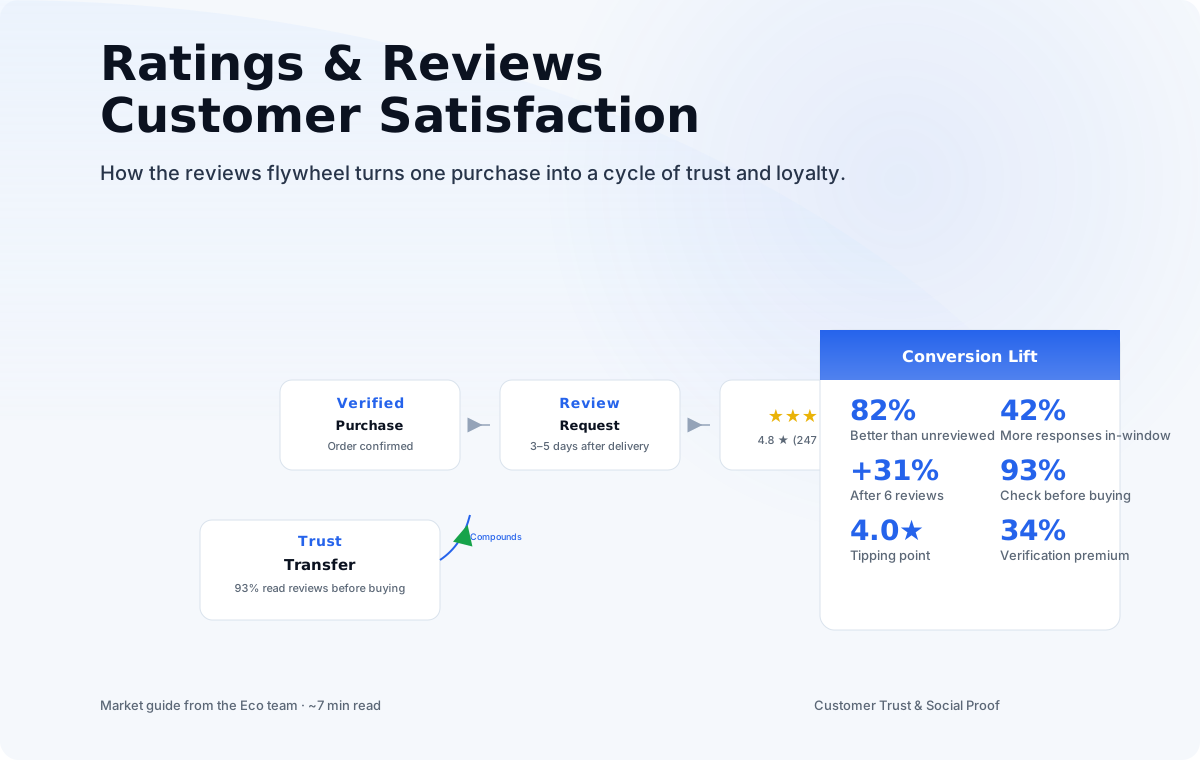
Products with 100+ verified reviews convert 82% better than unreviewed equivalents [1]. The lift is cumulative — each review amplifies the value of every review that came before.
But compounding has a twin: depreciation. A product that hasn't received a new review in six months sees a slow erosion of trust, even if its average score remains high. Shoppers interpret silence as abandonment — either by the brand or by the product itself. The flywheel only spins forward when it keeps turning: new reviews sustain the momentum that converts the next visitor [4].
The review satisfaction flywheel
Each stage feeds the next in a self-reinforcing loop.
Best practices: collecting reviews that actually help
Collecting reviews is easy; collecting good reviews is a discipline. The difference lies in three principles: ask at the right moment, ask the right way, and make it effortless.
Timing is everything
The single highest-yielding moment to request a review is 3 to 5 days after delivery. Too early and the customer hasn't used the product; too late and the memory has faded. Shopify Plus internal data shows that review requests sent within this window generate 42% more responses than those sent outside it [5].
The trigger isn't just when — it's why. A good review request reminds the customer of their purchase decision: "You chose the recycled tote because it was durable for daily use. How has it held up?" That contextual prompt produces reviews that are richer, more specific, and more useful to the next shopper.
Display matters as much as collection
Where reviews appear on the page directly affects how much trust they transfer. Eye-tracking studies by Baymard show that reviews placed below the fold but above the add-to-cart button achieve 23% higher engagement than those buried at the bottom of the page [6]. The lesson: reviews belong where the decision is made, not where the research ends.
"Reviews are not a testimonial section you forget about after launch. They are a living layer of trust that must be tended, curated, and surfaced at the moment of decision."
What Eco's integrated reviews module does
The challenge with reviews is that they rarely live in the same system as the product data they describe. Most stores bolt on a third-party review app, then manually reconcile the data: prices that drift between the product page and the feed, stock levels that lag, and reviews that can't be filtered by the promo codes a customer actually used. Eco eliminates that fragmentation by making reviews a native, first-party layer of the product record.
When a customer completes a purchase on Eco, the order is verified, the product is tagged as "purchased by this reviewer," and an automated email sequence kicks off — all driven by the same order record that powers the invoice and the loyalty points award. No data sync, no third-party cookies, no manual reconciliation.
Everything, from one product record
How Eco's reviews module integrates with the rest of the platform.
The result is a reviews system that doesn't just collect ratings — it composes them into the trust fabric of the storefront. Star ratings render on every product card by default. Review snippets appear in search results. Photo reviews populate the product gallery. And because reviews are tied to orders, not sessions, a customer who buys with a loyalty discount and leaves a five-star review gets their points awarded and their voice published — automatically.
From reviews to satisfaction: a merchant checklist
Ratings and reviews are most powerful when they are treated as a system, not a feature. Every touchpoint — collection, display, and follow-through — must reinforce the same message: your customers' voices matter, and their feedback makes the next shopper's journey safer and more confident.
What merchants see when it works
"We went from 12 reviews to 400 in six months. Conversion on reviewed products is up 45%, and repeat purchase is up 28%. Reviews didn't just help sales — they helped us understand what our customers really wanted."