
Sales vs Marketing: Why the oldest business feud still costs e-commerce millions.
Sales and marketing have clashed for decades — marketing says "the leads aren't ready," sales says "marketing sends us garbage." But in e-commerce there is no separate sales team to blame. The storefront itself must do both jobs: marketing attracts, and the product page, pricing, and checkout must close. When those two halves are out of sync, the cost is not a missed quota — it is abandoned carts, disapproved ads, and customers who bounce before they ever see the price. In this guide we break down why alignment is worth 208% more marketing ROI [1], how misaligned promises silently leak revenue, and how a single product record keeps every channel saying the same thing.
Market guide from the Eco team · ~7 min read
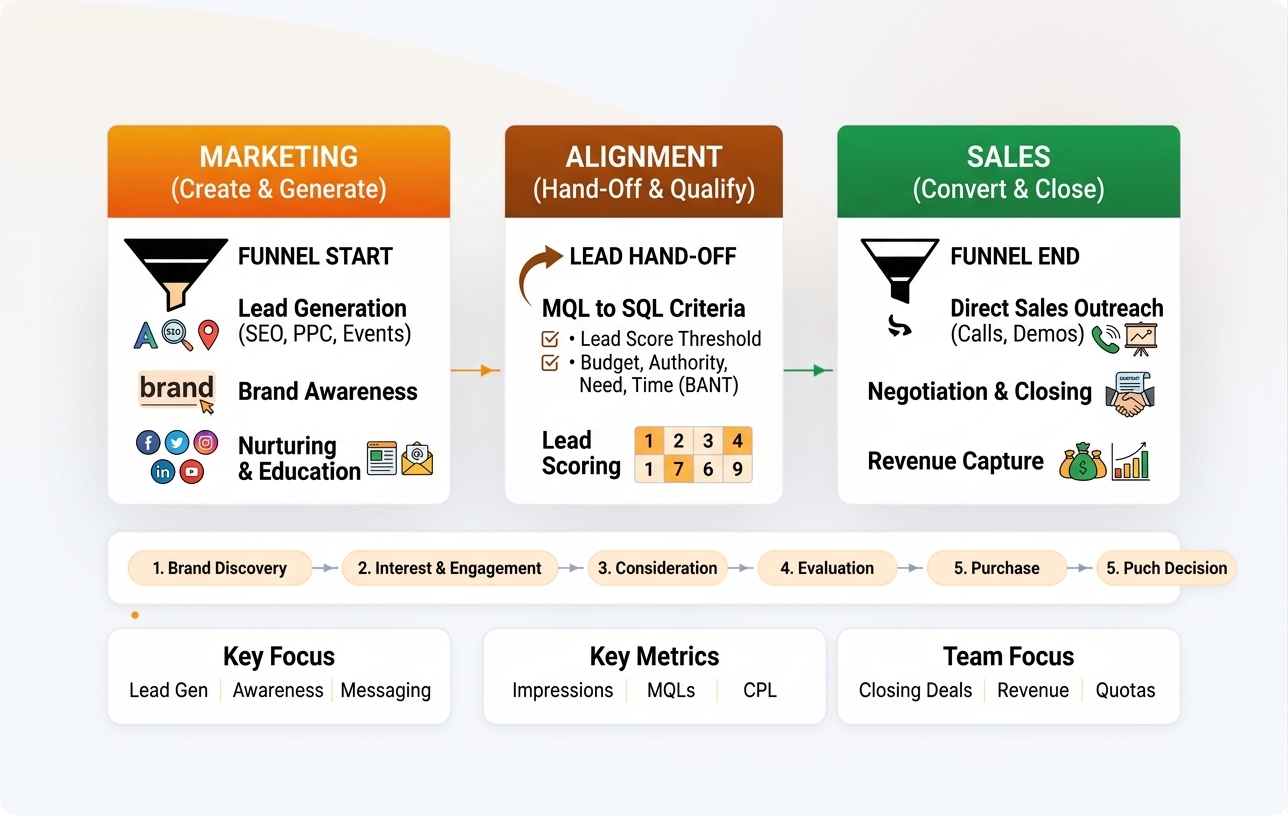
The feud that never left (and why e-commerce can't afford it)
In traditional B2B, the script is familiar: marketing generates leads, hands them off, and then watches sales complain that the data is stale, the contact is wrong, or the prospect "isn't sales-ready." The friction is organizational — two teams with different KPIs, different tools, different definitions of "qualified." The Harvard Business Review has documented this gap for over a decade: companies with aligned sales and marketing grow revenue 24% faster than their unaligned peers [4].
In e-commerce the feud takes a different shape — and it is invisible. There is no sales team to call marketing out, so the misalignment plays out silently as leakage: a Google ad promises "eco-friendly," the landing page agrees, but the product page has no such attribute. An abandoned-cart email says "only 3 left in stock," but the product page shows "in stock" indefinitely. Each mismatch is a micro-friction that chips away at conversion — and because no single team owns the whole journey, no one notices until the revenue report comes in.
The e-commerce alignment gap
Where the old B2B split re-appears in a world without a sales team.
In e-commerce, the product page is the sales floor
In a physical retail store, the salesperson is the bridge between the billboard outside and the shelf inside. They answer questions, correct misunderstandings, and adapt their pitch to each customer's objection. In e-commerce that role collapses onto the product page. There is no human to recover a misled expectation — the page must do it with copy, photos, reviews, and trust signals alone.
Baymard Institute's ongoing UX research shows that the product page is where 67% of shoppers' questions get answered before they add to cart[2]. That means the product page owns the final sale more decisively than any other surface. If marketing tells a story that the product page can't corroborate, the story dies there — and with it, the conversion.
| What marketing promises | What the product page must deliver | Gap risk if they drift |
|---|---|---|
| "Eco-friendly materials" | Material type attribute + badge on page | Returns, distrust, negative reviews |
| "Free shipping over $50" | Shipping tier shown in checkout | Cart abandonment at final step |
| "Only 3 left in stock" | Real-time inventory badge | Bounce if the page says "in stock" |
| "2-year warranty" | Warranty attribute + policy section | Customer service load, chargebacks |
The alignment gap: where promises leak into abandonment
The gap between marketing and the on-site experience is not one big failure — it is a thousand small ones, each invisible on its own but collectively devastating. Here is where e-commerce stores bleed revenue without noticing:
- Price drift — the ad says "$19.99" but the page shows "$24.99" after sync lag. Baymard finds that 46% of cart abandoners cite unexpected costs as a reason[3].
- Feature mismatch — the ad highlights "waterproof" but the product page spec table says nothing about water resistance. Shoppers bounce when the unique selling proposition is absent where they need it most.
- Inventory confusion — abandoned-cart emails promise restock, while the page shows the item as available. The trust signal breaks.
- Trust-signal fragmentation — ratings and reviews live in a third-party app, shipping promises live in a footer link, and the return policy lives in fine print. No single source of truth means every touchpoint can say something different.
"The difference between a 3% and a 5% e-commerce conversion rate is often not 'better marketing' — it is 'marketing and product telling the same story.'"
customer questions
unexpected costs
ROI when aligned
Revenue attribution: marketing's real report card
Here is the brutal truth about the sales-vs-marketing feud: most companies can't actually tell which marketing dollars produced revenue. Gartner's annual CMO survey finds that only 22% of marketers rate their ability to measure ROI as "successful" or "very successful"[5]. The reason is structural: attribution models are usually last-click by default, which means the channel that closes the sale gets all the credit — and the channel that built the awareness gets nothing.
In a properly aligned system, attribution traces the full journey: the awareness campaign that first introduced the brand, the comparison-shopping that narrowed options, the retargeting that brought the shopper back, and the final click that triggered the checkout. Only then can marketing prove its true contribution to revenue — and only then can sales trust the leads marketing delivers.
Last-click attribution credits only one touchpoint, missing up to 88% of the journey's influence[6]. Data-driven models in Eco attribute revenue across every interaction that shaped the decision.
How one system ends the feud
The root cause of the sales-vs-marketing gap in e-commerce is not culture — it is data fragmentation. Marketing uses one tool for campaigns, another for analytics, and a third for audience building. The product catalog lives in the store platform. Pricing changes in a spreadsheet. Inventory updates in the ERP. The moment these sources drift, the promise breaks.
Eco eliminates the gap by making the product record the single source of truth for everything: the storefront, the marketing assets, the ads, the emails, the analytics — everything reads from the same canonical record. When you change a price, a stock level, or a product attribute, that change propagates instantly to:
- Search and filtering — updated attribute data keeps products discoverable.
- Product cards and pages — the exact same price, stock, and badge the shopper saw in the ad.
- Marketing campaigns — auto-generated ad copy pulls the live price and availability so there is never a drift.
- Abandoned-cart and retention emails — these read the current product state, not a snapshot from 48 hours ago.
- Google Shopping and Meta feeds — product data feeds update in real time, so you never waste ad spend on disapproved or misrepresented listings[7].
One change → every surface updates
The Eco product record flows to marketing, storefront, and analytics together.
The result is not just technical consistency — it is cultural. When marketing can point to a campaign and say "that drove $X in tracked revenue," and sales can see that the visitors who arrived converted at the promised rate, the old feud dissolves. Both teams are measured on the same outcome: revenue.
Closing the sales-marketing gap: a merchant checklist
Alignment is not a strategy you declare — it is a set of technical habits you build. Here is how to audit your own operations.
What merchants see when it works
"We used to lose 15% of conversions to price drift between our ads and product pages. Once we unified everything on Eco, that leakage vanished overnight." [Eco testimonial]
"For the first time, marketing can show exactly which campaigns drove revenue — not just traffic. Sales and marketing finally agree on the numbers." [Eco testimonial]
Stores that eliminate price drift, feature mismatch, and inventory confusion see an average 23% lift in conversion rate.