
The value of maintaining statement management of invoices.
The moment an order is paid, most stores consider the job done. But the invoice is not the end of the sale — it is the beginning of a paper trail that answers "was this charged correctly, was it paid, and what is still open?" In this guide we lay out what proper statement management actually covers, why unmanaged invoices quietly inflate days-sales-outstanding, and how Eco keeps every order, refund, discount, and credit note reconciled on a single record.
Market guide from the Eco team · ~8 min read
The invoice is where a sale becomes money
A confirmed order proves a customer intended to buy. An invoice is the document that turns that intent into a collectible, auditable claim: who was charged, for what, at what price, under which terms, and against which payment. Between "order received" and "payment cleared" sits a gap where most e-commerce businesses lose their grip on the numbers — and it is exactly the gap statement management exists to close.
For a card-paid drop-shipper, that gap is seconds long, so the paperwork feels like bureaucracy. For anything with invoicing terms — B2B wholesale, purchase orders, net-15/net-30 trade accounts, partial payments, refunds, or credit notes — the gap is weeks, and the difference between a managed and unmanaged trail is cash flow. Atradius' payment-practices surveys across markets consistently find that trade credit is widespread in B2B commerce and that late payment is a structural feature of it, not an exception [1]. When a meaningful share of your revenue settles weeks after the order, the invoice ledger is your cash-flow forecast.
Even in pure consumer e-commerce, statement management is doing quiet work every day: the discount line from a promo code that must match what the shopper was actually charged [2], the refund credit note after a return, the tax totals the accountant needs at period close. All of it lives on the statement — or nowhere.
What statement management covers
Four documents, one ledger, no guessing.
The anatomy of an invoice and a statement
Statement management fails at the field level long before it fails at the policy level. An invoice that is missing an identifier, a tax breakdown, or a payment-term line is not a compliance document — it is a photo of an order. These are the fields that make the difference.
| Field | Why it exists | What it prevents |
|---|---|---|
| Sequential invoice number | Legal identity + unbroken sequence for auditors | Gaps, duplicates, and disputed "which version is real?" |
| Issue + due dates | Starts the payment clock and the aging bucket | Silent DSO creep nobody can explain |
| Line items + quantities | What exactly was billed, unit by unit | "I was charged for three but received two" standoffs |
| Discount ledger | Every promotion applied, per line, with its code | Margin reports that disagree with the customer's receipt [2] |
| Tax breakdown | Taxable base + rate + amount, not one lump sum | Painful period-close reconstruction |
| Payment terms + reference | Net-15/30, PO number, payment instructions | Payments that cannot be matched to an invoice |
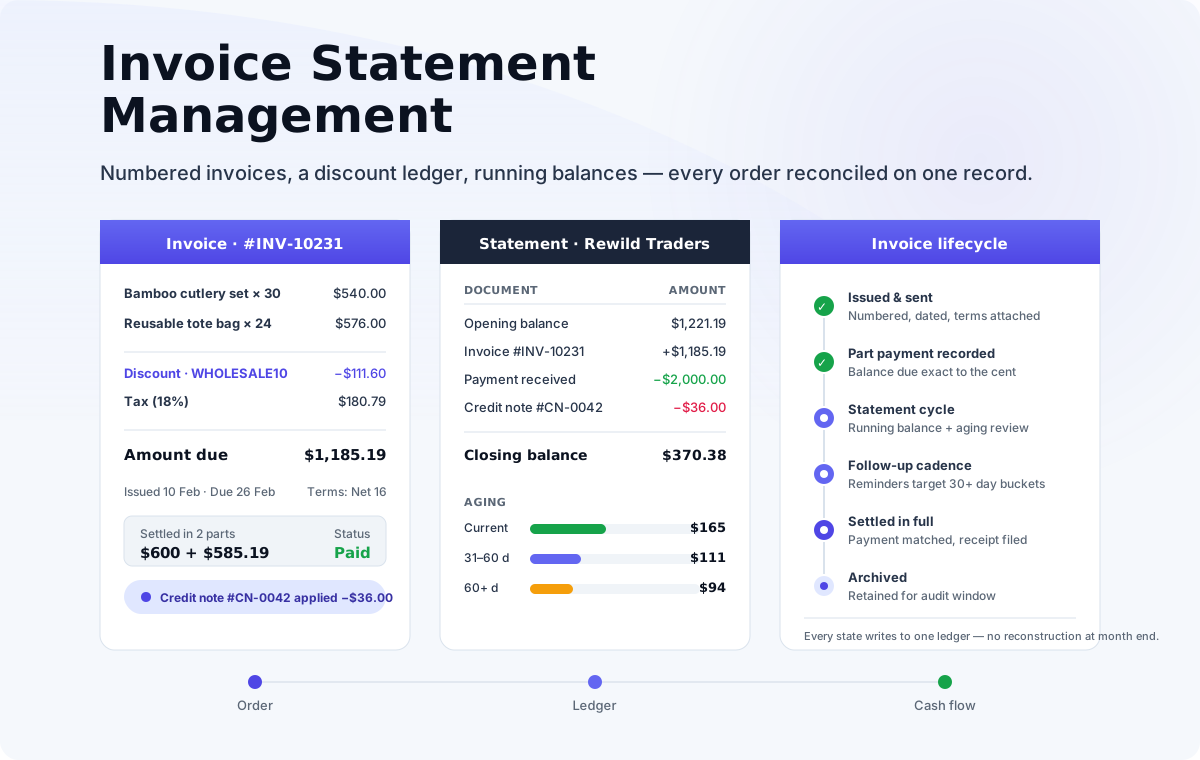
The statement of account sits one level above any single invoice. It is the running record for a customer: opening balance, each invoice issued, each payment received, each credit note applied, and the closing balance — so both sides can reconcile without shuffling PDFs. When a buyer's accounts-payable team asks "what do we owe you this month?", the answer should be a screen, not an archaeology project.
"A stack of invoices is data. A statement is the answer to 'what do we owe you?' — and it is the only document both sides can reconcile against."
The statement lifecycle: six states every invoice passes through
Managed statement management is not a filing habit — it is a lifecycle. Each state has an owner, a trigger, and a next event, and invoices that stall in any state for too long are precisely where cash flow dies.
awaiting confirmation
clock running
balance open
receipt matched
refund or correction
audit window
The two states businesses skip are part-paid and adjusted, and they are the two that break reconciliation hardest. A $1,800 order paid in two instalments looks, on a naive ledger, either fully unpaid or fully paid — never the truth. Likewise, a refund issued without a credit note leaves the invoice looking collectible forever. On Eco, both are first-class document types in the ledger, so the running balance on a statement is always exactly the amount still owed — no manual corrections in a spreadsheet.
Only the first bucket collects itself. Buckets two and three are what follow-up cadences, reminders, and statement cycles exist to recover [1].
What breaks when statement management is skipped
None of these failures announce themselves at the time they happen. They surface at month end, at audit, or when a customer disputes a charge from six weeks ago — which is precisely why the discipline is worth maintaining deliberately rather than repairing reactively.
- Disputes become unwinnable — without itemised, numbered invoices and an applied-credit ledger, every chargeback or billing dispute defaults to the customer's recollection of price and discount, not the platform's record of what was actually charged.
- Duplicate payments — a buyer whose AP team cannot match payments to invoices pays twice, then takes a month to notice and two more to reclaim. Every duplicate payment is avoidable admin and strained goodwill.
- DSO blindness — if nobody tracks aging buckets, overdue balances sit invisible until cash flow pinches, and the recovery window — when reminders actually work — has already closed.
- Audit and tax exposure — a gap in a sequential invoice series, or refunds with no credit-note trail, turns a routine period close into a forensic exercise. Regulatory expectations around invoice records exist precisely because the sequence itself is the control [3].
- Margin leaks hide in the discount line — a promotion applied at checkout but never carried onto the invoice means the revenue report and the customer's receipt never reconcile [2].
"Month end used to be three days of reconstruction. Now it is a report we read, because the statement was already the truth."
How Eco maintains the statement ledger for you
The reason most stores do not maintain invoice statements is not importance — it is effort. Reconstruction is manual, and manual does not survive volume. Eco writes the paper trail as a by-product of normal operation, from the same product-and-order record the storefront runs on:
- Numbered invoices generated from orders — every confirmed order produces a sequentially numbered invoice with line items, tax breakdown, and payment terms attached, not a PDF someone remembered to export.
- Discount ledger per line — every promo code applied appears as an explicit discount line with its code ID, so margin reporting, marketing attribution, and the customer's receipt all show the same number [2].
- Credit notes for refunds and cancellations — returns and corrections adjust the running balance through a proper credit note, so settled invoices stay settled and open balances stay honest.
- Part-payment support — instalments and partial settlements record each receipt against the invoice, leaving an exact balance due instead of a guess.
- Running statements & aging — every customer statement shows opening balance, activity, and closing balance, with balances bucketed by age so follow-up targets the right invoices.
- Export-ready for the accountant — the ledger exports complete for tax and bookkeeping systems, so period close reads a report instead of rebuilding one.
One ledger, every document
Orders, payments, and corrections as one record on Eco.
The compounding benefit is cultural: once the statement is trustworthy, conversations change. Finance stops reconstructing and starts forecasting; customer service answers "what do I owe?" from a screen; and the question at month end shifts from "what happened?" to "what should we do about the 60+ bucket?"
Statement management: a merchant checklist
Whether you invoice ten customers a month or ten thousand, these are the controls that keep the paper trail — and the money it represents — intact.
What merchants see when it works
"Wholesale buyers used to dispute our invoices because the discounts weren't itemised. Once every code showed as a line, disputes basically stopped — and re-orders got easier." [Eco testimonial]
"The aging view showed us $40k sitting in 60+ days. One statement cycle and a follow-up sequence recovered most of it — money we'd written off as 'slow payers'." [Eco testimonial]
Stores that issue statements on a fixed cycle and review aging weekly typically pull days-sales-outstanding down by 15–30% within a quarter.