
The contribution of promo codes to your e-commerce platform.
A promo code looks like a single text field at checkout, but it is the most over-worked lever in commerce: it converts hesitant shoppers, attributes revenue back to the channel that earned it, and decides — for better or worse — how much of your margin survives the order. In this guide we separate what each type of code actually buys you, show where ungoverned codes quietly leak profit, and how Eco's single promotion engine keeps every code tied to a budget, a rule set, and a clean invoice.
Market guide from the Eco team · ~7 min read
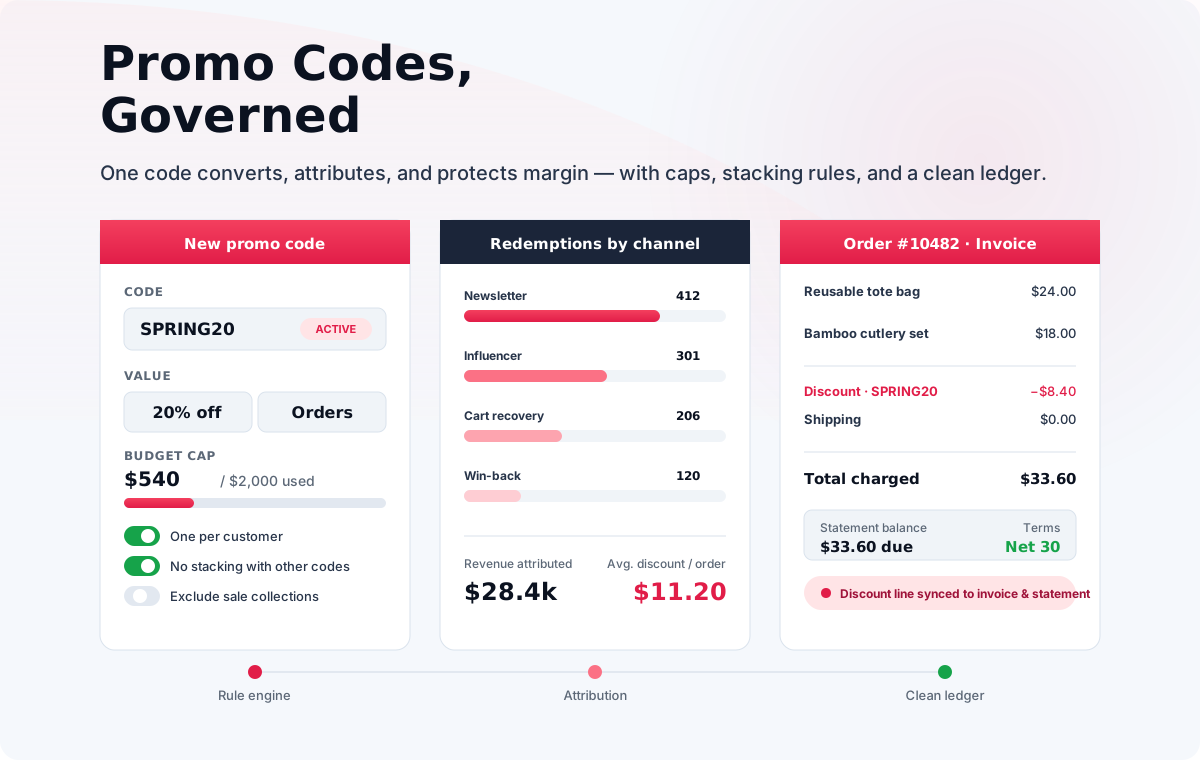
One field, three jobs: convert, attribute, protect
Most merchants meet promo codes as a blunt instrument: "take 10% off." But a well-run promotion is doing three jobs at once, and only the first is about the shopper in front of it.
What a single code actually does
Treated as a feature, the text field becomes a measurement system.
Job one is the obvious one — clearing the "is it worth it?" stall. RetailMeNot's consumer research finds that 80% of shoppers feel encouraged to make a first-time purchase with a new brand when they can find a discount or coupon [1]. A code that is easy to discover converts the "not now" browser into a first-order customer — and the first order is the only thing a new store cannot buy later.
Job two is where codes earn their keep in operations. Every other marketing channel reports "traffic"; a unique code reports revenue by source. The influencer who posts PODCAST10, the abandoned-cart email that sends COMEBACK15, the newspaper insert with NEWSPRING25 — each becomes a measurable line item instead of a hopeful spend. That is why the humble discount field is often the most honest attribution system a small store owns.
Job three is the one that gets forgotten until finance finds it. A percentage code with no budget cap is an open cheque. The contribution of a promo-code feature is therefore not "we can give discounts" — it is "we can give discounts with limits, rules, and receipts."
"An unlimited discount is not a promotion. It is a price cut you failed to measure."
The anatomy of a well-governed code
A promo code is not a string — it is a rule object. Six properties decide whether it converts or leaks, and every one of them belongs in the platform record, not in a spreadsheet held by whoever set the campaign up.
| Property | The question it answers | What breaks without it |
|---|---|---|
| Type & value | Is it 10% off, $10 off, free shipping, or BOGO? | Margin varies wildly per order — the cost is unplanned |
| Conditions | Minimum spend? Eligible products or collections only? | Discount stacks on loss-leader items and single-item carts |
| Usage limits | Total redemptions cap? Per customer? | The code leaks to coupon aggregators and fires a thousand times |
| Stacking rules | Can it combine with other codes or automatic discounts? | Two 20%-off codes become 40% off — silent margin destruction |
| Validity window | When does it start and hard-stop? | "Flash sale" codes keep working for months |
| Channel / audience | Who is it for, and how did they get it? | No attribution, no list hygiene, everyone gets the same offer |
Stacking is the rule that pays for itself
If you enforce one rule first, make it this one. A single-discount-per-order policy — with an explicit exception list — is the difference between "10% promotion" and "36% promotion you didn't budget for." Two perfectly reasonable-looking campaigns (10% site-wide plus 15% for newsletter subscribers) silently become 25% off when both apply, and the loss only shows up in the month-end margin report. On Eco, stacking is decided per code at creation time, so the worst-case cost of every promotion is knowable before a single shopper redeems it.
new brand with a code [1]
aggregators within days
20% codes stack
The code types that pay for themselves
Not every discount should look the same. The type of code you pick is a bet on which behaviour you are buying, and mixing them up — a first-order code for a loyal customer, a win-back code for a new visitor — is how discount budgets get spent without revenue attached.
| Code type | Best for | Guardrail to set on day one |
|---|---|---|
| First-order welcome | Acquisition — converts the hesitant new shopper | One per customer, tied to a new-subscriber list |
| Free shipping threshold | Cart-size lift — the cheapest lift in the catalog | Threshold ~1.6x AOV so it pays for itself |
| Cart abandonment | Recovery — targeted, time-boxed, expiring | Validity window of hours, not weeks |
| Win-back / lapsed | Retention — re-activates 60–90 day sleepers | Restricted to customers with zero orders in window |
| Partner / influencer | Attribution — measures the channel precisely | Unique code per partner, personal usage cap |
| BOGO / bundles | Velocity — moves slow stock with margin intact | Eligible products only, never store-wide |
The shipping threshold deserves special mention because it is the only discount that usually raises order value: unexpected costs — shipping, fees, taxes — are the reason 46% of shoppers abandon carts [2], and a clear, achievable threshold answers that objection by adding items to the cart rather than shaving margin off the sale.
Threshold and cart-specific codes out-convert store-wide percentage codes because they answer a concrete reason-to-buy [2].
The four leaks every ungoverned promo program springs
Discount failures are rarely dramatic. They accumulate — a code shared on a coupon forum, a percentage applied to a collection it was never meant for, a "one per customer" rule nobody configured. Here is where the money goes:
- The aggregator leak — a generic code posted publicly is scraped by coupon sites within days and redeemed by customers who would have paid full price anyway. The fix is the boring one: per-customer limits, single-use allocation, and expiry dates that are actually enforced.
- The stacking leak — automatic promotions and manual codes combine into a discount nobody authorised. The fix is an explicit, default-deny stacking policy.
- The wrong-audience leak — acquisition discounts handed to loyal, full-price customers. The fix is audience gating: a first-order code should reject an email that has already purchased.
- The reporting leak — discounts recorded nowhere at checkout. A $10 code that never reaches the order record, the invoice line, or the statement makes every later reconciliation a guessing game (we cover the invoice side of this in our statement-management guide [3]).
"We didn't lose money on discounts. We lost money on a 20% code that ran for nine months because nobody could remember whose campaign it belonged to."
Know the worst case before you launch
The discipline that separates grown-up promotion programmes from coupon spaghetti is a worst-case cost calculation: if every code you're running right now were redeemed by every eligible customer at full value, what would the month's discount bill be? If nobody on the team can answer that in one screen, the programme is unmanaged — however good the conversion numbers look.
How Eco's promotion engine keeps codes accountable
Most platforms treat a promo code as a string and let every other system improvise around it. Eco models the discount as a first-class record in the same product-and-order graph as everything else, which means the rules, the reporting, and the accounting all read from one source:
- One rule engine — type, value, conditions, audience, validity, and usage caps are all properties of the code itself, visible and editable in one place.
- Default-deny stacking — codes never combine unless you explicitly allow it, so the worst-case cost of your promotion mix stays calculable.
- Budget caps — a hard limit on total discount value or redemption count, after which the code retires itself. No more nine-month leaks.
- Channel attribution — partner, campaign, and win-back codes roll straight into revenue reports, so the discount line item IS the channel report.
- A clean discount ledger — every redemption writes a discount line to the order, which flows to the invoice and the customer's statement of account, so margin reporting and finance reconciliation never diverge from what the shopper was charged [3].
One code → every system agrees
The Eco promo record is the single source of truth for discounting.
The strategic point is that promo codes stop being marketing's private lever and become a governed growth instrument: conversion gains on one side of the ledger, capped costs on the other, and an audit trail that finance, marketing, and the store owner all read the same way.
Running a promo programme: a merchant checklist
Whether you run one campaign a quarter or fifty a week, these are the habits that keep discounts additive to profit instead of subtractive from it.
What merchants see when it works
"We moved every campaign onto Eco codes with caps and per-customer limits. Same conversion lift as the old wild-west codes — 40% less discount spend." [Eco testimonial]
"The discount ledger landing straight on the invoice ended a two-person reconciliation job we used to do every month end." [Eco testimonial]
Stores that add caps, stacking rules, and audience gating to live campaigns typically reclaim 30–45% of previous discount spend at the same conversion rate.